
 admin
admin
Politics has always involved persuasion. But in modern times, persuasion has increasingly been replaced by strategic manipulation of perception. In political warfare today, the most important battle is not always over facts—it is over the interpretation of those facts.
Those who control the narrative often control public opinion. And public opinion, in turn, shapes elections, policy decisions, and the direction of a nation.
Perception as a Political Strategy
Human beings are not purely rational creatures. We process information emotionally before we process it logically. If an event can be framed in a way that triggers outrage, sympathy, fear, or moral urgency, people will form an opinion before they examine the underlying facts.
Perception manipulation does not require outright lies. The most effective narratives contain a mix of truth, omission, and emotional framing. The goal is not necessarily to deceive everyone. The goal is simply to move enough people in a desired direction.
A Recent Example: The Young Mariachi Detention Case
A recent case involving young mariachi musicians in South Texas illustrates how quickly perception can shape political narratives.
In February 2026, federal immigration authorities detained members of the Gámez-Cuéllar family, including two teenage boys who were part of a nationally recognized high school mariachi program in McAllen, Texas. Their detention quickly went viral after images and videos of the young musicians circulated online.
The story spread rapidly across social media and news outlets. Many posts framed the situation simply as “a talented young mariachi arrested by Homeland Security.” The emotional framing – young musicians and immigration enforcement – generated immediate outrage across the country.
Within days, politicians from both parties and community activists demanded their release. After the controversy gained national attention and bipartisan criticism, the family was ultimately released from immigration custody.
The incident revealed something important: the narrative around an event can become more influential than the event itself.
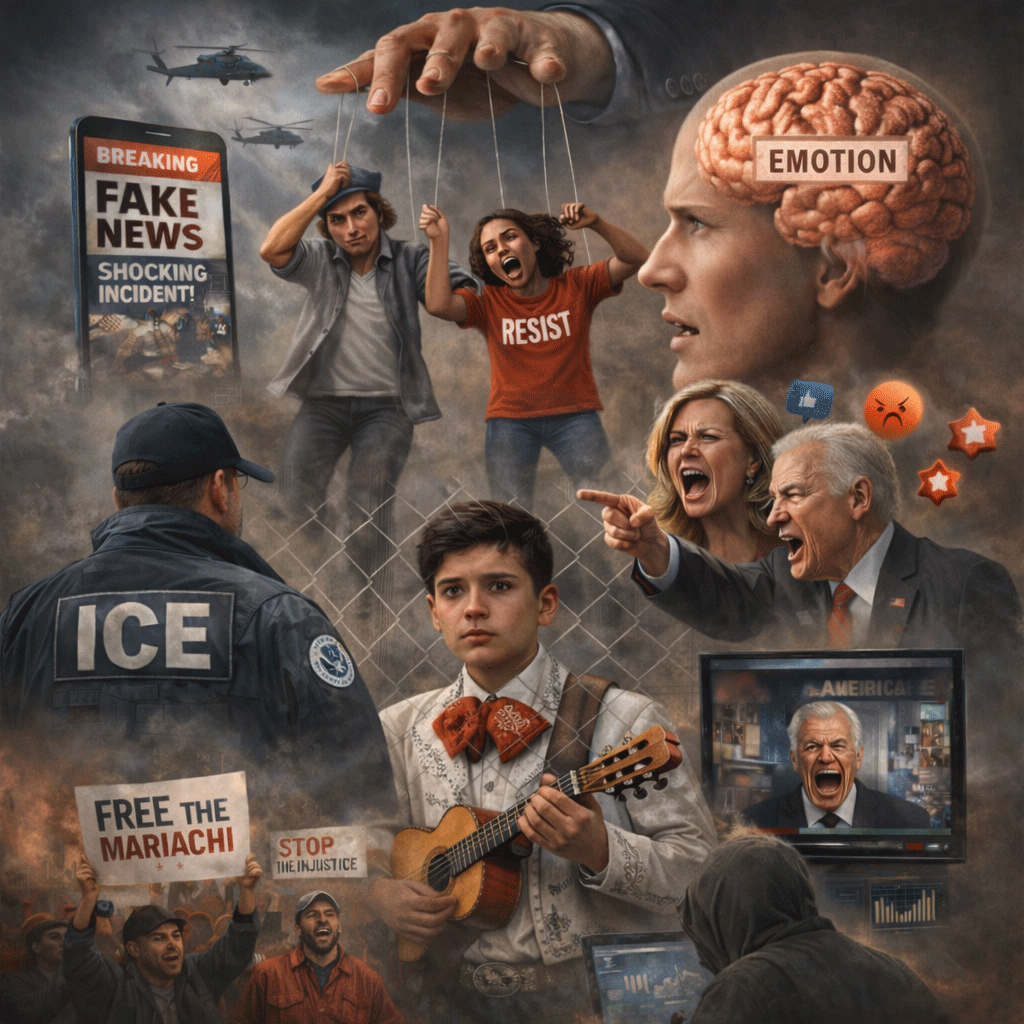
Why Perception Campaigns Work
Stories like this gain traction because they activate emotional triggers that bypass careful analysis. Facts, figures, truth, and statistics don’t matter to the emotional brain.
Several psychological dynamics are at play:
- Emotional imagery dominates rational analysis.
A story involving a sympathetic figure, especially a young person, creates immediate empathy. Once emotions are activated, people often adopt a position before examining details. - Social media accelerates outrage.
Platform algorithms reward emotionally charged content with greater visibility. The more outrage a story generates, the more it spreads. - Simplified narratives replace complex realities.
Political issues are often complicated. But viral narratives reduce them to simple moral stories: hero versus villain, victim versus oppressor.
When this happens, nuance disappears.
The Vulnerability of the Uninformed
The individuals most vulnerable to perception manipulation are those who do not recognize that such tactics exist.
If a person assumes that every viral story represents the full truth, they will inevitably be guided by whichever narrative is most emotionally compelling. They will become participants in a political strategy without realizing it.
This does not mean every emotional story is false. Many involve genuine hardship or injustice. But the key question responsible citizens must ask is not simply what happened—it is how the story is being framed and why.
The Responsibility of Citizens
A healthy republic requires citizens who can recognize when perception is being used as a political weapon.
That requires discipline:
- Asking what information may be missing from a viral story
- Distinguishing emotional framing from verified facts
- Recognizing when a narrative is being used to mobilize political pressure
Citizens who fail to develop these habits become easy targets for manipulation.
In the end, perception may influence politics – but truth must remain the standard by which responsible citizens judge political narratives.
A free society cannot survive if its people surrender their judgment to whatever story spreads fastest on social media. And in an age of information warfare, learning to see beyond perception may be one of the most important civic skills of all.
Author: Joseph Vargas