
 admin
adminThe United States has long been a beacon of liberty — a nation built on individual rights, free enterprise, and the rule of law under a constitutional republic.
Millions around the world look to America as a place of hope, opportunity, and freedom.
Yet in recent decades, immigration — both legal and illegal — has exposed a deep challenge to that founding ideal.
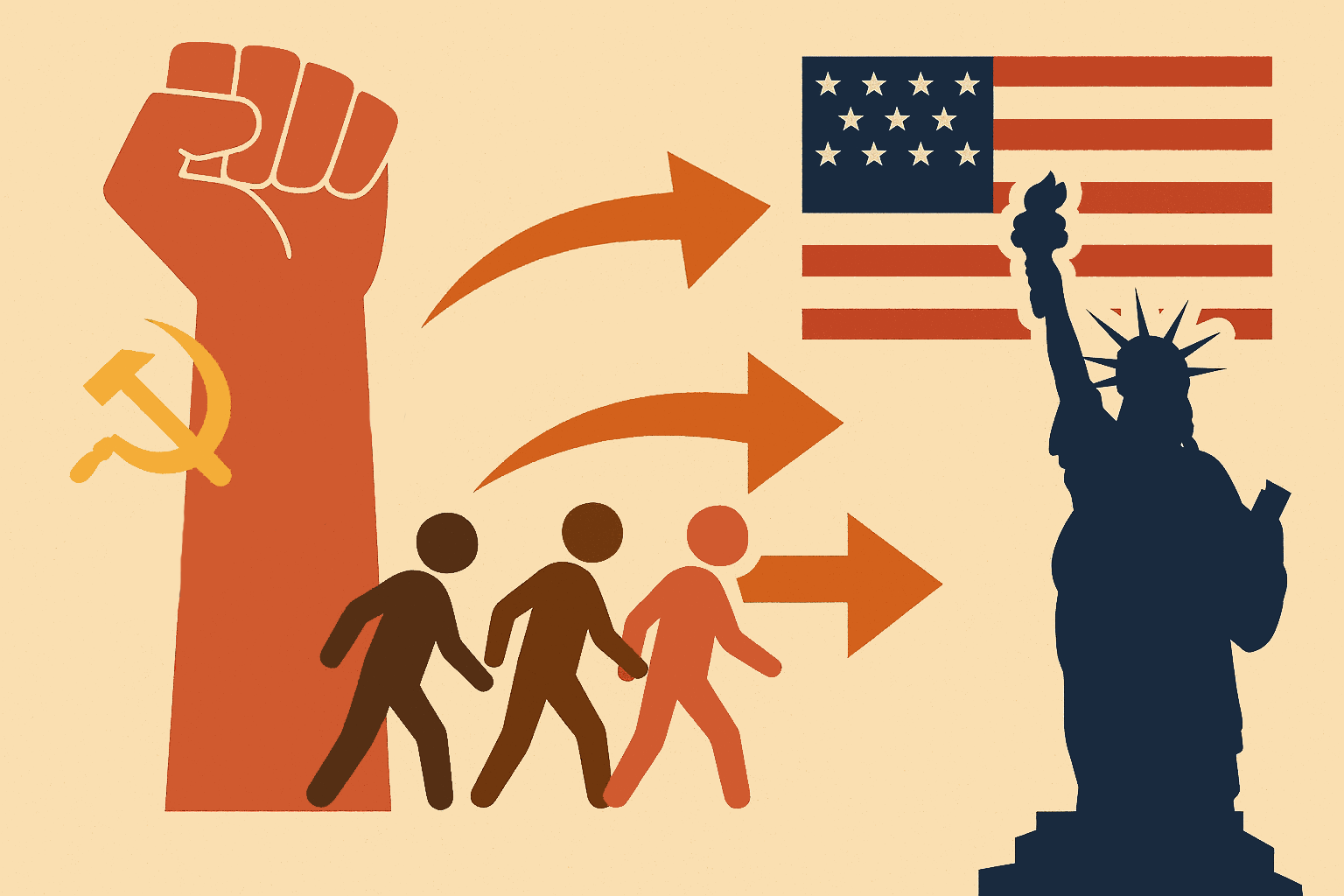
A significant portion of immigrants—both legal and illegal—come from countries governed by socialist and authoritarian governments. Though they seek freedom from poverty, corruption, and political oppression, many retain the same socialist political ideology that failed them.
Rather than embracing the limited-government ideals that make America exceptional, they gravitate toward candidates who promote the same failed expansive government programs from their countries of origin. Thus, the Democratic Party’s promise of government-funded “free” services sounds familiar and appealing to many of these immigrants.
This is an ideological and cultural problem. A constitutional republic can only survive when its people understand, value, and defend the principles that sustain it. If immigrants are not taught what makes America different, they will destroy the freedoms they came seeking.
AMERICA’S FOUNDATIONAL PRINCIPLES AT RISK
The Founders rejected pure democracy, warning that it leads to mob rule and eventually tyranny. Instead, they established a constitutional republic — a system designed to secure and protect the people’s God-given rights through checks and balances and the rule of law. The core idea was that government exists to protect freedom, not manage every aspect of life.
Likewise, capitalism was more than an economic choice; it grew out of a moral belief in individual autonomy, private property, and personal responsibility. It promotes innovation and upward mobility while rejecting dependency on the state.
These foundational truths created the freest, most prosperous nation in history. Yet today, many immigrants — and even native-born Americans — lack an understanding of these principles. This endangers and makes freedom vulnerable.
THE IDEOLOGICAL BAGGAGE OF SOCIALIST NATIONS
People raised under socialism often view government as the primary source of security, resources, and decision-making. When they immigrate to the United States, they expect the state to provide housing, healthcare, and education. They see free markets as unstable or unfair. They believe redistribution is necessary for “justice.”
Such viewpoints may not come from malice. They could result from generations of conditioning. But if those assumptions go unchallenged, immigrants can gradually reshape American politics into something resembling what they fled.
THE INFLUENCE OF THE SAO PAULO FORUM
The ideological challenge is not random. Global coordination is behind it. The Foro de São Paulo (São Paulo Forum), founded in 1990 by Brazilian socialist Lula da Silva and Cuban dictator Fidel Castro, unites socialist and communist parties across Latin America. Its mission is to spread socialism through cultural, political, and economic influence.
Member parties include those currently in power in several Latin American countries, including Mexico. The ruling Mexican party, MORENA, led by President Claudia Sheinbaum, is affiliated with this movement. Thus, many immigrants from Mexico and South America hold socialist political views shaped by this organization, making them receptive to Democratic politicians who favor similar promises.
They flee socialism — but bring socialism with them.
ASSIMILATION VS. MULTICULTURALISM
Historically, immigrants wanted to become Americans. They learned English, adopted American civic traditions, and taught their children loyalty to the country that gave them the opportunity to a better life. Cultural customs were cherished, but national identity was embraced.
Today, radical multiculturalism rejects the idea of a unified American identity. It promotes the message that immigrants do not need to adapt to America — America must adapt to them. The result? Linguistic and cultural separation, political tribes based on ethnicity, and parallel communities with conflicting values.
A republic cannot function without a common civic foundation. When immigrants embrace loyalty to the country that failed them over the country that offered them opportunity, national unity erodes.
ECONOMIC CONSEQUENCES OF NON-ASSIMILATION
America’s free-market success depends on personal responsibility, a strong work ethic, and productive competition. Immigrants who embrace these values build businesses, strengthen communities, and contribute to prosperity.
But those who come to America with expectations of government caretaking increase the burden on taxpayers. A growing welfare-dependent population expands government power, increases tax demands, and drives political support for redistributive policies.
This gradually replaces free enterprise with state control — destroying the American Dream they sought.
CULTURAL AND CIVIC CONSEQUENCES
A constitutional republic requires citizens who respect the law, value liberty, participate in civic duty, and uphold moral standards.
When immigrants resist assimilation, these virtues weaken. Political corruption, imported from failed socialist regimes, begins to creep into local politics. Eventually, ethnic voting blocs support candidates who promise favors rather than defend constitutional principles. Identity politics, not liberty, becomes the organizing force.
Corrupt candidates exploit this shattered mindset by campaigning and promising loyalty to a specific race, religion, or a foreign country they still consider their motherland.
RESTORING THE AMERICAN MODEL OF ASSIMILATION
The goal is not to close America’s doors, but to guard America’s soul. Patriotism must supersede any tribal allegiance. A renewed emphasis on personal responsibility is crucial. Churches, schools, and communities must unify around these values. Diversity becomes a strength only when grounded in unity of purpose.
Real assimilation should once again be a national expectation grounded in civic education, American cultural identity, and emphasis on personal responsibility. Immigrants must learn and appreciate not only how to live in America, but why America is exceptional, unique, and worth defending.
– Author: Joseph Vargas