
 admin
adminThe Small-Town Friendship Trap
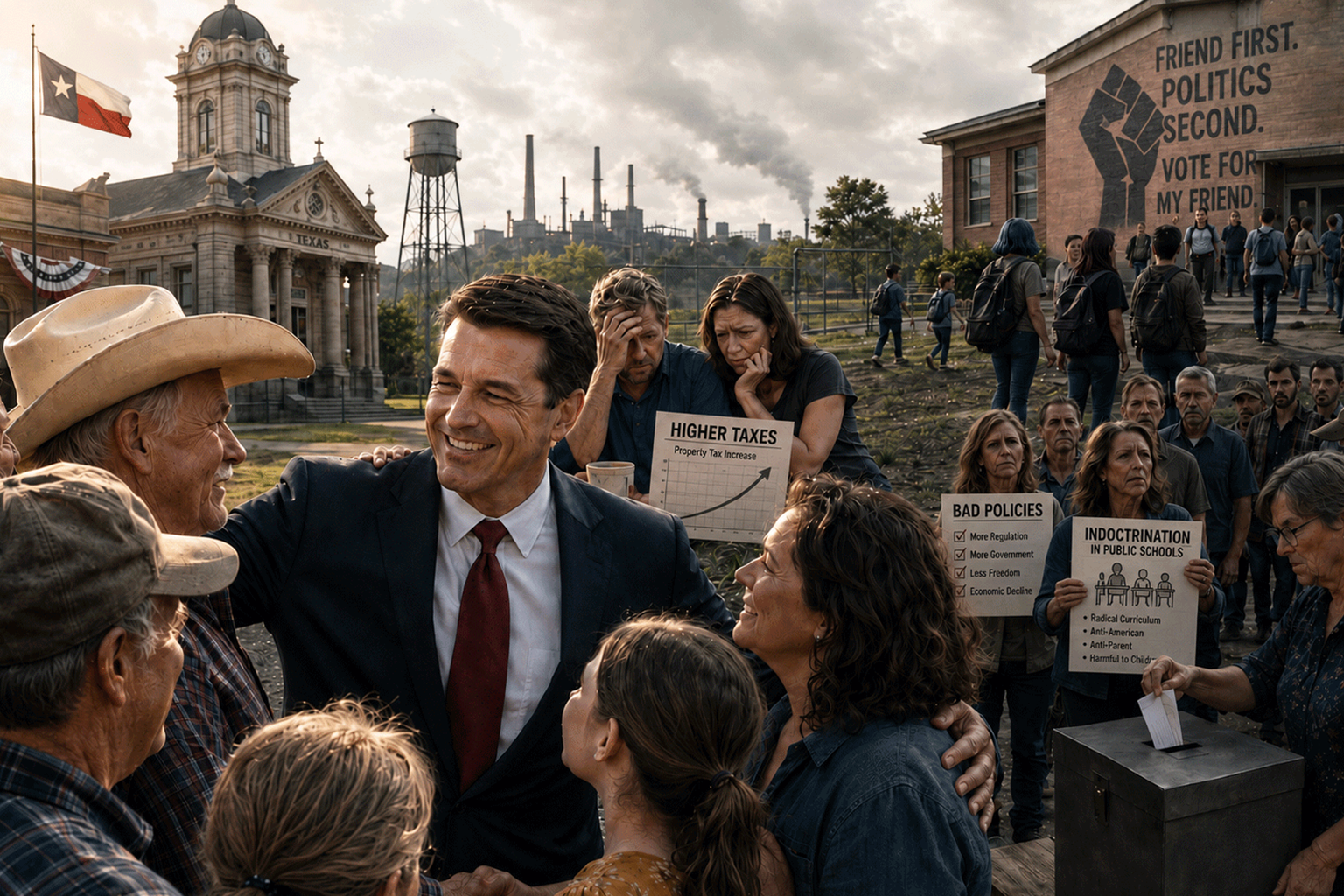
One of the greatest political dangers hurting local communities is the inability of citizens to separate personal friendship from public accountability.
This problem is especially common in smaller cities, where voters know elected officials personally through churches and civic groups. These relationships can strengthen a community, but they can also cloud political judgment.
Local officials may repeatedly vote to increase taxes, approve excessive spending, appoint leftist activists to local boards and commissions, usher in mass surveillance infrastructure, or ignore citizens who object to their community’s direction.
School board members may dismiss parents’ concerns, adopt ideological policies, change school names to satisfy leftist activists, ignore inappropriate books in schools, approve controversial curricula, waste budget resources on nonessential initiatives, or weaken academic and disciplinary standards.
Yet when election season arrives, many voters say, “Yes, he voted against me and my family’s interests, but he is a good person and my friend, so I will vote for him again.”
This is known as the small-town friendship trap. It is not responsible citizenship. It is emotional voting.
Public Office Is Not a Friendship Award
Public office is not a reward for being friendly or popular. It is a position of public trust.
Elected officials are entrusted with tax dollars, schools, public safety, and decisions affecting families for generations. They must be judged by their records, not by how kindly they greet us at church or community events.
A person can be pleasant in private and damaging in public office. A friendly personality does not compensate for higher taxes, weakened standards, ignored citizens, or policies that burden our children. Friendship should never become political immunity.
Benjamin Franklin Chose Liberty Over Family Loyalty
Benjamin Franklin understood that some principles are greater than personal relationships. Although he and his son William were once close, the American Revolution placed them on opposing sides. Benjamin supported independence, while William, the royal governor of New Jersey, remained loyal to the British Crown. Their disagreement caused a lasting rupture, and they had no contact for years.
William was not merely Franklin’s friend or neighbor. He was his son. Yet Franklin believed America’s liberty was more important than preserving family harmony.
If Franklin could stand for freedom at the cost of his relationship with his own son, why is it so difficult for us to oppose harmful policies simply because the elected officials imposing them are our “friends”?
Forgiveness Does Not Require Re-Election
Forgiveness is a Christian virtue, but it does not require us to return political power to someone whose decisions are harming our families and endangering our children’s future. We can care about a person personally while still concluding that they should no longer hold public office.
When an elected official raises our taxes, weakens our institutions, dismisses our concerns, and supports policies that damage our children’s future, we must ask an honest question: Is that person truly acting as our friend?
Familiarity Is a Psychological Tactic
This psychological trap is affecting citizens across Texas, including many who consider themselves firmly committed to their values. Personal familiarity lowers our defenses, allowing friendship to outweigh voting records, tax increases, broken promises, and harmful policies.
Citizens spend years complaining about government while repeatedly re-electing the officials responsible for the decisions they oppose. They criticize the consequences but continue protecting the people who caused them. In doing so, voters become participants in the very decline they claim to resist.
Our Children Will Pay the Price
Representative government requires emotional maturity. We must distinguish between liking someone personally and trusting that person with political power.
Our families will inherit the government we tolerate. Our children will live with the debt, declining institutions, weakened standards, and lost freedoms that today’s voters excuse in the name of friendship.
As I have repeatedly warned:
“There’s no such thing as a corrupt government. Only a complacent electorate.”
Author: Joseph Vargas