
 admin
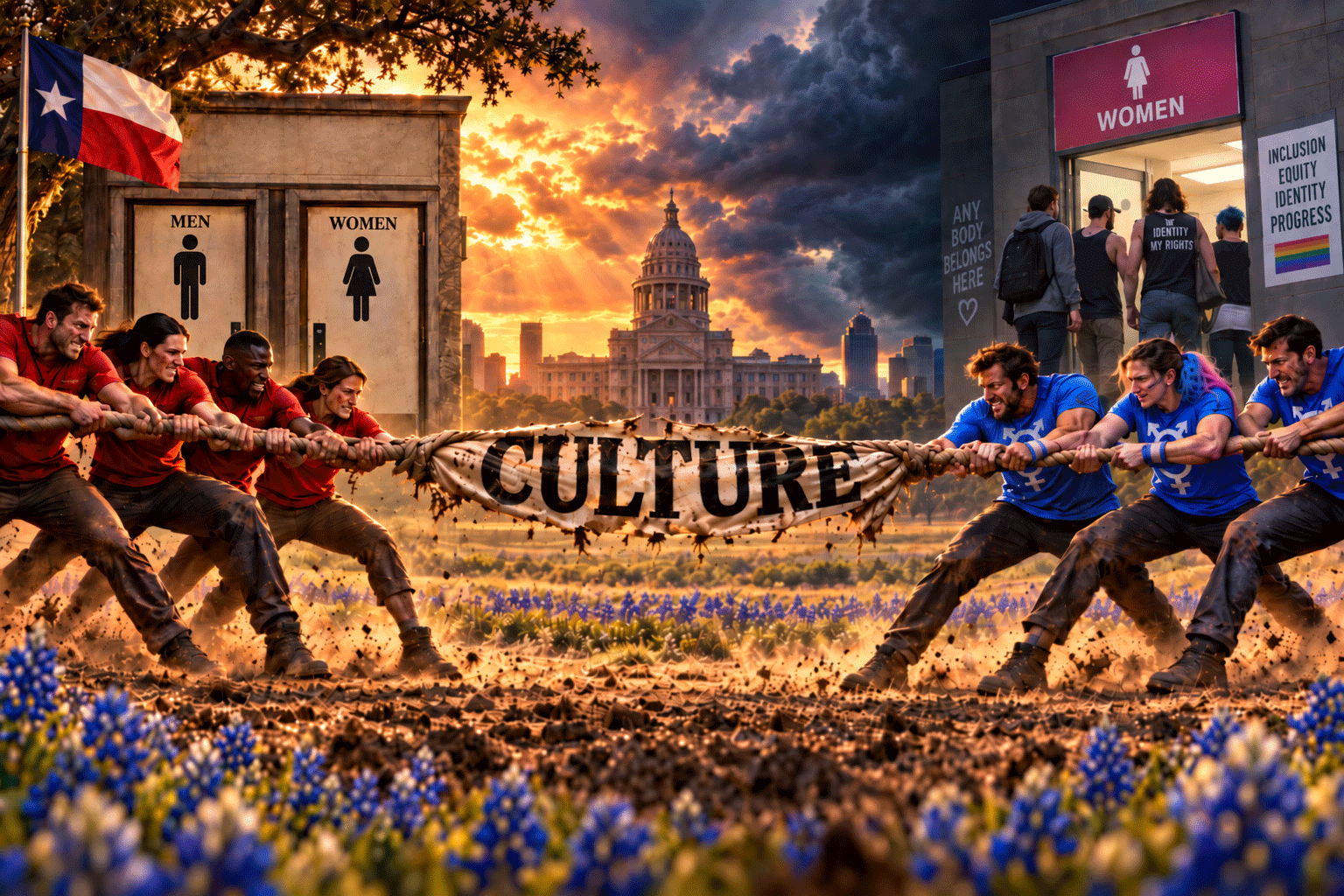
adminWhenever Republicans raise questions about biological sex, transgender athletes, bathrooms, parental rights, or gender ideology in public schools, Democrats increasingly respond with the same accusation: Republicans are waging a “culture war.”
Texas Democrats Gina Hinojosa and James Talarico have made that argument part of their 2026 campaigns. At the Texas Democratic Convention, both accused Republican leaders, including Gov. Greg Abbott and Attorney General Ken Paxton, of focusing on divisive cultural issues.
But this raises a deeper question: Who actually started the culture wars?
Republicans did not suddenly decide to redefine bathrooms, athletic categories, pronouns, or the words man and woman.
It was Democratic administrations and institutions who sought to abruptly incorporate gender identity into laws and policies involving discrimination, schools, bathrooms, athletics, and other sex-separated institutions.
Republicans have simply responded by trying to preserve biological-sex distinctions in those areas.
When the Definitions Changed
Traditionally, the legal and social categories of male and female were based primarily on biological sex. Recent gender-identity frameworks introduced a different concept: biological sex and gender identity could be distinct, and a person’s gender identity could determine whether that individual should be treated socially and legally as a man, woman, or another gender category.
That distinction moved from activism into government policy.
It is important to note that Democratic policy defines gender identity as an individual’s self-identified gender – regardless of biological sex.
In 2016, the Obama administration issued Title IX guidance stating that federal agencies would treat a student’s gender identity as the student’s sex for Title IX enforcement, including access to sex-separated school facilities. The Trump administration later withdrew that guidance.
The Biden administration went further. Its 2024 Title IX rule expanded prohibited sex discrimination to include discrimination based on gender identity. A federal district court vacated that regulation in January 2025.
Once government applies gender identity to laws historically based on sex, the debate reaches bathrooms, locker rooms, athletics, schools, workplaces, pronouns, medical policies, and other areas traditionally organized around biological sex.
Rights or Redefinition?
To appear virtuous and inclusive, Democrats frame transgender policies as questions of civil rights, equality, and protection from discrimination. They transformed an ideological argument about gender into a legal question, and then characterized resistance to that transformation as discrimination.
However, before government can declare that someone’s rights have been violated, it must first answer a basic question: What do the words “man,” “woman,” “male,” and “female” actually mean?
Democrats avoid answering this question because once those terms are given fixed definitions, their arguments about gender identity become difficult to sustain.
When definitions become vague, almost any policy can be recast as a matter of rights.
Bathrooms, Sports, and Schools
In Texas, Republican lawmakers have enacted legislation requiring certain sex-separated facilities to be used according to biological sex. Texas law also requires public-school athletes to compete according to biological sex recorded on their original birth certificate.
In 2025, Senate Bill 12 prohibited public schools from providing instruction, guidance, activities, or programming regarding sexual orientation or gender identity to pre-K through 12th-grade students and required parental consent for human-sexuality instruction.
Democrats have opposed such restrictions, arguing that they discriminate against transgender Texans or interfere unnecessarily with individuals, families, doctors, and local institutions.
Yet something politically significant is happening in 2026.
Hinojosa and Talarico are emphasizing economics rather than leading their campaigns with many of the Democratic social issues that have generated national controversy.
Talarico has gone further. On September 9, he reversed his earlier position on transgender participation in girls’ sports, saying he opposes it when it threatens safety or competitive fairness.
That creates an obvious question:
If these cultural disputes are merely manufactured Republican distractions, why is Talarico reversing course on a previous position while Hinojosa and other Democrats increasingly avoid the very social issues they once defended?
If elected, with their prior records and party positions, Hinojosa and Talarico would very likely return to supporting many of the same gender-identity and cultural policies they are now trying to deemphasize.
The Real Texas Crossroads
Texas voters approaching the 2026 midterm election face different philosophies concerning biology and identity, parents and government, schools and children, individual rights and longstanding institutions.
The question facing Texas is no longer whether a culture war exists. The policy record provides evidence that, on gender, Democratic administrations initiated the conflict by extending gender identity into civil-rights rules governing schools and sex-separated spaces, prompting Republican efforts to reassert biological-sex distinctions.
Consequently, Texas now stands at a cultural crossroads: What should the law recognize when biological sex and gender identity conflict, and should the changes of the past decade be preserved, expanded, or reversed?
Author: Joseph Vargas