
 admin
admin
Few phrases capture the American experiment more powerfully than E pluribus unum. Translated from Latin, it means “Out of many, one.” It appears on the Great Seal of the United States and on our currency, yet its meaning is increasingly misunderstood and sometimes stretched beyond what its creators intended.
Its American origin goes back to the founding. On July 4, 1776, hours after approving the Declaration of Independence, the Continental Congress appointed Benjamin Franklin, Thomas Jefferson, and John Adams to develop a seal for the new nation. Their first proposal was not adopted, but one element survived: E pluribus unum. Congress formally adopted the Great Seal on June 20, 1782.
The phrase itself was not invented by the Founders. London’s Gentleman’s Magazine, widely read in the American colonies, is the probable source for the motto. But the meaning assigned to it on America’s Great Seal is much clearer.
The original American meaning was quite specific: many separate states joined together to form one nation. Charles Thomson, Secretary of the Continental Congress, made that meaning clear when he presented the final design of the Great Seal in 1782. In his official explanation, Thomson wrote that the shield represented “the several states all joined in one solid compact entire” and that “The Motto alludes to this union.”
In other words, E pluribus unum referred to the union of the states into one nation. The Great Seal reinforces that meaning through repeated references to the original 13 states – 13 stars, 13 stripes, and 13 arrows.
The U.S. Department of State reaches the same conclusion in its official history of the Great Seal: E pluribus unum “expresses the union of the 13 States.” The National Archives also describes the phrase as representing the formation of a single nation from thirteen colonies.
That distinction matters.
The original “many” did not refer to foreign cultures being promised permanent separation from an American identity. They referred to thirteen states joining together as one nation. The emphasis was not division. It was union.
Today, E pluribus unum is frequently invoked in debates over immigration and multiculturalism as though it means America must continually surrender its customs, language, traditions, and national identity to every foreign culture that arrives here.
That is not what the motto originally meant.
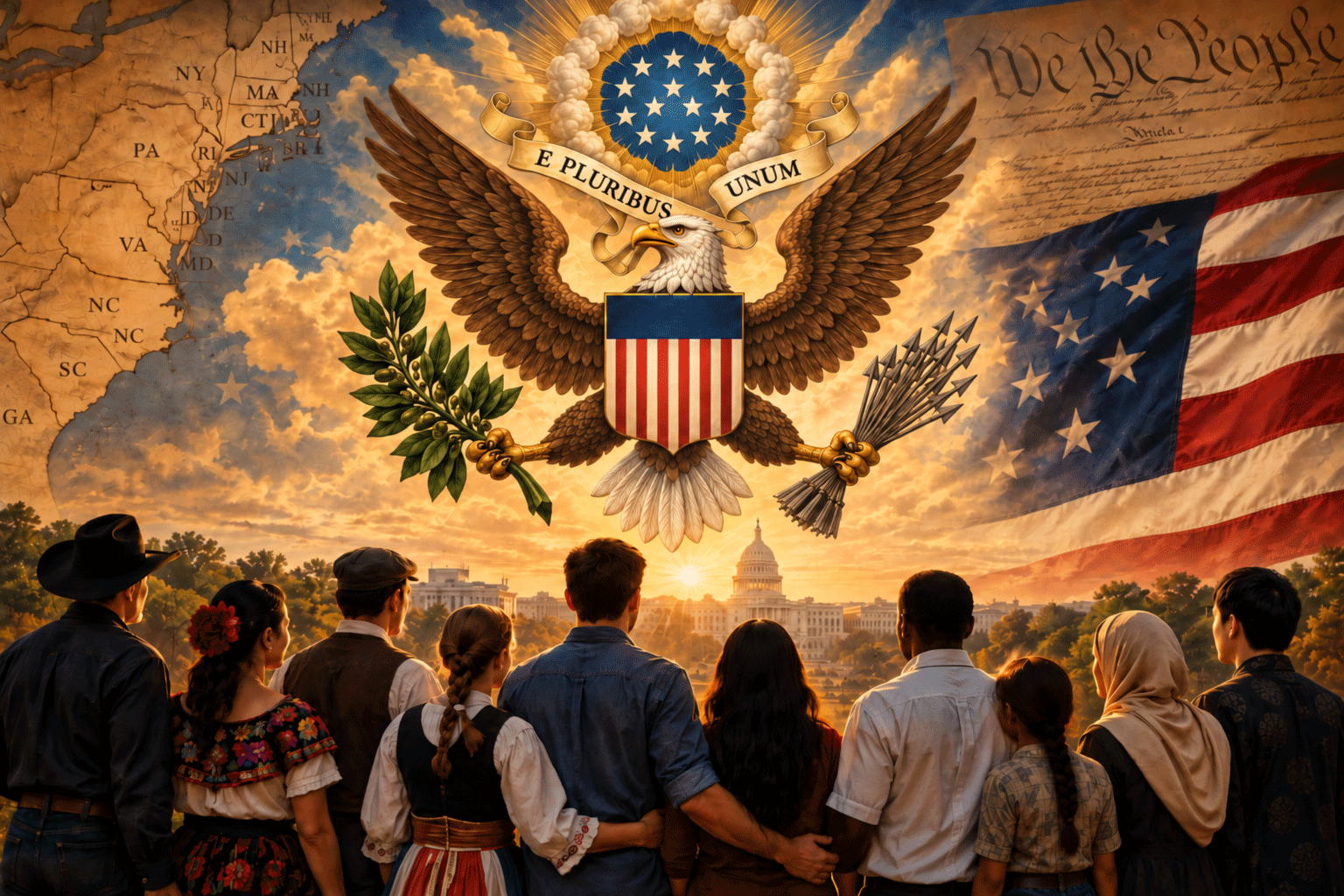
Immigrants have always contributed to America. Germans, Irish, Italians, Poles, Mexicans, Asians, and countless others have contributed foods, music, religious traditions, businesses, and customs to American life.
Honoring your ancestry and becoming fully American are not contradictory. But cultural contribution should enrich America, not require America to surrender its own traditions and identity.
The traditional American ideal was assimilation into a common national identity. The immigrant did not have to erase his ancestry; he became part of something larger than it. He could remember where his family came from while embracing the language, history, Constitution, civic traditions, and loyalties of the United States.
The many became part of the one. America absorbed new influences, but absorption and replacement are not the same thing.
Yet today the motto is sometimes turned upside down. We are told that respecting diversity requires American culture to accommodate every incoming tradition and that expecting newcomers to assimilate is intolerant.
Under that interpretation, E pluribus unum quietly becomes something closer to “Out of one, many” – one national culture increasingly divided into separate cultural identities.
That interpretation is a distortion of the motto’s original meaning. The official explanation of the Great Seal does not describe thirteen cultures remaining separate. It describes thirteen states forming a union. The symbolism points toward unity.
E pluribus unum contains both ideas for a reason: pluribus and unum – the many and the one. Diversity without unity eventually produces fragmentation. America’s genius was allowing enormous individual, religious, regional, and cultural variety while maintaining a common American identity.
We should therefore be careful when America’s symbols are redefined to advance modern political arguments. Before repeating what someone tells us E pluribus unum means, read the historical record.
It does not mean America must apologize for having a culture. It does not mean American traditions must surrender to foreign traditions. It means separate parts came together to become something greater:
One nation.
If we intend to preserve Americanism, we must first understand it. Know our history. Know our symbols. Know what they meant before others redefine them for us.
The motto begins by acknowledging the many. But it does not end with pluribus.
It ends with unum.
Out of many, one – not out of one, many.
Author: Joseph Vargas