
 admin
adminOne of the biggest mistakes conservatives make in political conversations is answering every question exactly as it is presented.
Many political questions are not neutral. They contain assumptions, labels, or moral judgments. By answering too quickly, you may unknowingly accept someone else’s definition of the issue.
That is why effective political communication requires learning to recognize the question behind the question.
Before responding, ask yourself three things:
What am I being asked to assume?
What standard am I being asked to accept?
Is that standard being applied consistently?
Do not immediately answer the surface question. First, identify the frame and determine what principle or standard is actually being introduced.
Do Not Automatically Accept the Frame
During one of my presentations, I encountered a good example when someone hollered:
“Are you anti-vax?”
I could have responded, “No, I’m not anti-vax,” and immediately begun defending my position. But by doing so, I would have accepted both the “anti-vax” label and the frame.
Rather than accepting that frame, I tested the standard behind it.
My response was:
“I am so pro-vax that I support a mandate on the birth-control shot to prevent unwanted pregnancies and abortions. Are you with me, ma’am?”
Her response was silence.
I continued:
“Would you support mandating other vaccines and shots, like the birth-control shot, or just the COVID vaccine?”
Again, her response was silence.
Notice I did not accept the “anti-vax” label. Instead, I redirected the conversation toward the underlying standard:
If someone supports government coercion in one medical circumstance but rejects it in another, what principle explains the difference? That is the question behind the question.
When Someone Introduces a Moral Standard, Test It
I encountered another example during a presentation.
A woman told me:
“My Christian values don’t allow me to vote for Ken Paxton.”
I could have immediately begun defending Paxton. But that would have accepted the issue exactly as she framed it.
Instead, I focused on the standard she herself introduced:
Christian values.
My response was:
“Do your Christian values also condemn James Talarico’s support for abortion, transgender ideology, and his comments that God is nonbinary?”
I did not argue any other issue. I simply took the standard she claimed to be using and asked whether she was applying that standard consistently.
If Christian values are the reason she cannot support one candidate, then those same Christian values should influence how she evaluates the beliefs, policies, and public positions of the alternative candidate.
The broader question becomes:
What does it mean to apply Christian principles consistently when choosing between political candidates?
That is the question behind the question.
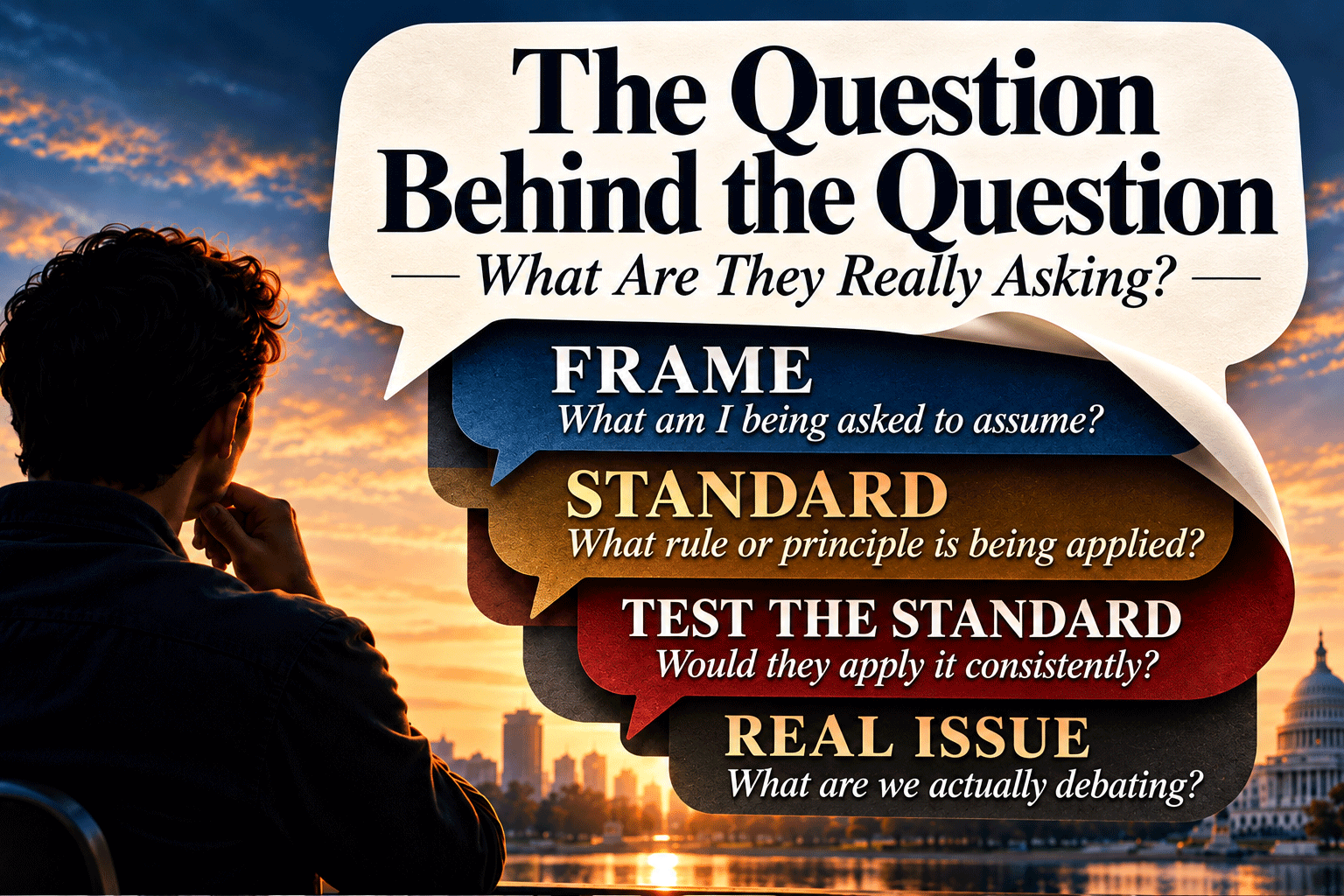
Identify the Frame. Identify the Standard. Test the Standard.
This technique comes down to three simple steps.
First, identify the frame.
What assumption, label, or conclusion has already been built into the question?
“Are you anti-vax?” contains a label.
“So you don’t care about children?” contains an accusation.
“My Christian values won’t allow me to vote for this candidate” introduces a moral framework.
Before answering, recognize what the wording is asking you to accept.
Second, identify the standard.
What rule, principle, or moral value is being invoked?
Is the standard personal freedom? Government authority? Christian morality? Fairness? Compassion? Constitutional rights? Public safety?
Once the standard is identified, the real argument becomes much clearer.
Third, test the standard.
Would the person apply that same standard if the candidate, political party or circumstance changed?
If government should have the power to mandate one medical intervention, under what principle should it be prohibited from mandating another?
If Christian morality disqualifies one candidate, is the same moral scrutiny being applied to the alternative?
If offensive speech should be restricted, would the person support restricting speech with which he agrees?
People often apply principles selectively. The objective is not simply to shout, “Hypocrisy!” That usually ends the conversation. The objective is to make people examine whether the principle they introduced is being applied consistently.
Do Not Dodge the Question—Find the Real One
Responding to the question behind the question does not mean refusing to answer a criticism. It means understanding what accepting its wording may require you to concede.
Political communication is heavily influenced by framing. Whoever defines the terms of the discussion often determines where the discussion goes.
So when someone hands you a loaded label, do not automatically accept it. When someone invokes a moral principle, identify the standard. Then test whether that standard is being applied consistently.
Because in politics, the most important question is usually not the one being asked. It is the one hiding behind it.
Author: Joseph Vargas